
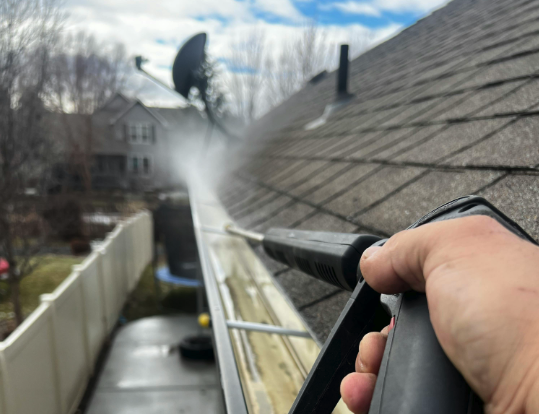
You climb the ladder twice a year, scoop the leaves, and check gutter cleaning off the list. The problem is that most tools in your garage were never designed for roof-edge work, and the wrong one turns a $200 chore into a $15,000 roof replacement.
Asphalt shingles lose granules. Aluminum gutters dent. Flashing lifts where you forced water under it. Here are nine common gutter cleaning tools destroying your roof, plus what actually works.
1. Pressure Washers Strip Granules Off Your Shingles
A pressure washer in the gutters seems efficient until you see the granules washing down the driveway. Those granules are the protective layer on every GAF, Owens Corning, and IKO asphalt shingle, and once they wash off the asphalt bakes in UV and fails years early.
Most consumer units run 1,500 to 4,000 PSI. Architectural shingles are not rated for that at point-blank range. The spray ricochets off the gutter bottom and drives up under the first course, lifting tabs and saturating the underlayment.
You will see bare black spots near the eaves and curling within two summers. A full roof replacement runs $5,000 to $25,000, and pressure washer damage often voids the warranty. If you are weighing the timeline, getting a new roof walks through it.
Put the pressure washer back. A garden hose with a basic nozzle moves debris without sandblasting your roof.
2. Metal Scrapers Gouge Through Gutter Sealant
Metal trowels and rigid scrapers feel right for packed sediment, but they cut straight through the sealant at every seam. That bead is the only thing holding your sections watertight, and one careless scrape opens a slow leak you will not notice until a stain appears on the soffit.
Aluminum is soft. A steel edge scratches through the protective oxide, exposing raw aluminum that pits within a season. Once corrosion starts at a scratch line, it spreads along the entire run.
Replacing damaged sections runs $8 to $15 per linear foot, and a typical home carries 150 to 200 feet. Resealing seams adds $200 to $400. This is the bill flagged in home repairs that get expensive fast.
Use a plastic gutter scoop. They cost under $10 and will not destroy what they are cleaning.
3. Telescoping Wand Attachments Force Water Under Shingles
Telescoping gutter wands look safe because you stay on the ground. The catch is that the curved tip blasts water sideways and upward at the exact angle that drives moisture under your shingles.
Asphalt shingles overlap to shed water flowing downward. Water sprayed up into that overlap pools on the underlayment and reaches the deck. A roofer pulling shingles a year later will find rotted decking right above the gutter line.
Partial shingle repair near the eaves runs $300 to $1,500, and that assumes the deck is still sound. Edge intrusion is one of the likely causes of water damage homeowners never trace back to gutter cleaning.
Clean from a ladder with a hand scoop and a gentle hose. The wand is the most expensive shortcut on this list.
4. Wire Brush Attachments Tear Through Galvanized Coatings
Wire brushes on a drill or pole feel productive on caked sediment, but they were designed for rust removal. The steel bristles strip the zinc off galvanized steel gutters in seconds and tear through the factory finish on aluminum just as fast.
Once the galvanizing is gone, raw steel rusts on the next rain. You will see orange streaks down your siding within months, and rust spreads under the coating until the gutter develops pinhole leaks along the run.
Replacing rusted gutters runs $8 to $15 per linear foot, and rust stains add $500 to $1,500 to repaint. This is the slow-build problem in critical maintenance issues homeowners neglect.
Soak packed debris with water and lift it out with a plastic scoop. Wire brushes have no business inside a gutter.
5. Leaf Blowers Aimed Wrong Drive Water Behind Flashing
A leaf blower clears dry debris fast, but the angle matters more than the airflow. Most homeowners sweep the nozzle along the gutter, forcing air and wet leaf bits straight at the drip edge and behind the step flashing.
Flashing is sealed with a thin bead of caulk and gravity. Two hundred mph wind under it lifts the seal and pushes leaf fragments into the gap, where they hold moisture against the sheathing. You will not notice until you smell mildew in the attic.
Water remediation behind compromised flashing runs $1,500 to $10,000 depending on how far the moisture traveled. A walkaround like the ones in things homeowners should check monthly catches the early stains.
Blow dry debris only and aim down the gutter run, never up under the shingles or flashing.
6. Walking on Shingles to Reach Gutters
The most damaging gutter cleaning tool is your own feet. Every step on an asphalt shingle grinds granules loose and prints a wear pattern into the surface. Three-tab and architectural shingles both show foot traffic damage within one cleaning season.
The damage is worse on hot days when the asphalt softens. You press your shoe pattern into the shingle, displacing granules into the gutter where you scoop them out without realizing roof life just shortened by years.
Premature roof replacement costs $5,000 to $25,000 and rarely qualifies for warranty coverage when granule loss traces to foot traffic. This is one of the overlooked household hazards nobody warns you about.
Clean from the ladder. If you cannot reach a section, move it.
7. Ladders Leaned Directly Against the Gutter
An aluminum gutter is a thin-walled channel held to the fascia by hidden hangers every two to three feet. Leaning a ladder against it puts your body weight on a single point engineered for water, not 200 pounds of homeowner.
The result is a permanent dent that disrupts the slope toward the downspout. Water pools in that low spot, debris collects, and the section pulls away from the fascia. Once a hanger separates, the next storm tears the rest off.
Replacing a damaged section costs $8 to $15 per linear foot, and fascia repair adds $5 to $10 per foot. A $30 stabilizer prevents both bills, the kind of fix in secrets home inspectors withhold.
Use a ladder standoff that rests on the roof above the gutter.
8. Robotic Gutter Cleaners That Crack Open the Seams
Battery-powered gutter robots that crawl the channel look like the gadget answer to ladder work. The catch is that they vibrate hard, and that vibration concentrates at every seam, end cap, and miter joint.
Sealant beads are not designed for sustained vibration. After two or three cycles you find drips at the corners on the next heavy rain. The robot also gets stuck on hangers and spins in place, grinding the same spot until something gives.
Resealing every seam runs $250 to $600, and a cracked miter means $8 to $15 per foot for a new run. Robots trade one chore for a new repair line item.
If you cannot climb a ladder, hire a pro twice a year for less than the robot plus the re-seal.
9. Mesh Gutter Guards Installed Under the Shingles
Many DIY mesh guards and cheaper installer crews slide the back edge of the guard up under the first course of shingles to anchor it. That sounds clever until you realize you just lifted every shingle tab on the eave and broke the factory seal strip underneath.
The seal strip bonds each shingle to the one below it and is the main defense against wind uplift. Once lifted, those tabs will not re-bond. The first 50 mph gust peels them back and water gets under the entire eave course.
LeafFilter, LeafGuard, and reputable installers mount guards to the front lip or a hidden bracket for this exact reason. Gutter guard installation runs $7 to $13 per linear foot done right, and a re-roof to fix lifted shingles hits $5,000 to $25,000.
If a quote says “tucks under the shingles,” walk away. Done right, guards belong with things that protect home value.
What Actually Works: The Slow, Boring Method
The right approach looks unimpressive on video. A stable ladder with a standoff, a plastic scoop under $10, a bucket on a hook, and a garden hose with a basic nozzle. That kit protects a $5,000 to $25,000 roof for a decade.
Clean twice a year, in late spring and after the last leaves drop. Scoop dry debris into the bucket, then flush each section toward the downspout. Inspect each seam and hanger and reseal anything questionable before it leaks.
If you cannot do the work yourself, hire a local pro for $150 to $300 per cleaning. That is far cheaper than the $1,500 to $10,000 water damage bill, and it pairs with the prevention in smart upgrades that increase home value.
Skip the pressure washer, the wire brush, and the robot. Use the boring tools twice a year and your roof will outlive the gadgets.
- 0shares
- Facebook0
- Twitter0
- Pinterest0