
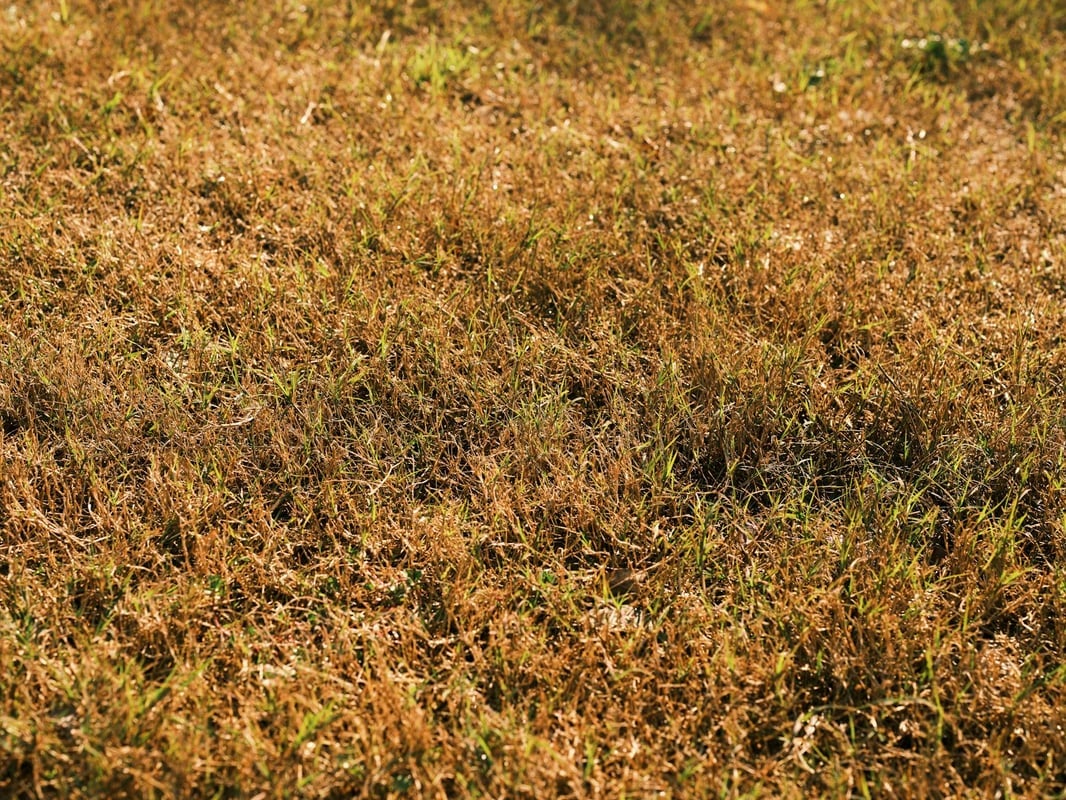
You have spent hundreds on fertilizer, weed killer, and bagged treatments, yet your fescue or Kentucky bluegrass looks worse than last summer. The honest answer is usually the bag in your garage, not the lawn itself.
Most lawn damage starts with the wrong product applied at the wrong time or rate. A full reseed runs $500 to $2,000, and sod restoration costs $1 to $2 per square foot plus around $1,000 in install. A $15 to $25 soil test would have prevented most of it. Here are seven products and practices quietly killing your grass.
1. High-Nitrogen Synthetic Fertilizer Applied Too Heavily
That 30-0-0 bag of Scotts Turf Builder or generic urea fertilizer promises a fast green-up, but the salt index of synthetic nitrogen burns roots when you apply over the bag rate. Damage shows up as yellow streaks following your spreader pattern within four or five days.
Concentrated nitrogen pulls moisture out of the grass crown and the soil microbes around it. Your fescue or Kentucky bluegrass pushes shallow top growth, the roots cannot keep up, and the first hot week scorches the whole yard.
Replacing a burned cool-season lawn costs $500 to $2,000 in seed and labor, or $1 to $2 per square foot plus around $1,000 in install if you sod it. A slow-release product like Milorganite at the recommended half-pound of nitrogen per 1,000 square feet feeds the lawn without the burn. Before you spread anything else, work through the three common lawn care mistakes that compound fertilizer damage.
2. Broadcast Weed-and-Feed Across the Whole Lawn
Scotts Turf Builder Weed and Feed, Ortho WeedClear, and similar combo products tell you to spread them across every square foot of grass. That blanket approach hits ornamentals, vegetable beds, and shallow tree roots with the same herbicide load as the dandelions.
The 2,4-D and dicamba in most weed-and-feed bags move through soil and through tree root zones. Maples, oaks, and dogwoods within 30 feet of the lawn can show curled leaves and dieback the following spring. Damaged ornamental trees often need professional care that runs $300 to $700 per visit before they recover.
You also waste most of the herbicide. Less than 10 percent of a typical lawn is actually weeds, so 90 percent of what you spread does nothing except contaminate soil and drift into beds where you planted the flowers that anchor your front yard.
Spot-spray broadleaf weeds with a selective product instead. A $20 pump sprayer and a pint of concentrate treats the same lawn for less than the cost of one combo bag.
3. Glyphosate Drifting Onto Your Lawn From Driveway Spraying
Roundup and other glyphosate products are non-selective, which means anything green that catches the spray dies. Homeowners spraying driveway cracks or fence lines on a breezy day lose three-foot strips of grass on either side without realizing why.
Even a fine mist of glyphosate moves into the soil, gets absorbed by adjacent roots, and kills out to the spray edge over the next two weeks. The brown stripes that follow your patio or driveway are almost always drift damage, not heat stress.
Reseeding a 200 square foot drift kill costs $80 to $150 in seed and starter fertilizer plus weeks of watering. If you sod it for instant cover you are looking at $200 to $400 once you add install. For a worked example of the right way to handle persistent weeds, the best ways to get rid of weeds guide walks through targeted application.
Use a shielded sprayer or a brush-on applicator within six feet of any turf. Spray only when wind is under 5 mph and the forecast is dry for 24 hours.
4. Aggressive Dethatching of a Healthy Lawn
Power dethatchers and vertical mowers pull up matted dead grass, but most lawns do not need them every year. Running aggressive blades across Kentucky bluegrass or zoysia with less than half an inch of thatch tears out living crowns along with the dead material.
You can lose 30 to 50 percent of the living grass density in a single pass on the wrong setting. The lawn looks shredded for the rest of the season, weeds move into the bare strips, and you spend the next year recovering the stand you used to have.
The repair tab on a botched dethatching runs $500 to $2,000 for full reseed and overseed work. A $15 to $25 soil test plus a screwdriver check of your thatch layer will tell you whether you needed to dethatch at all. Most homeowners do not.
Core aerate instead if compaction is the real problem. Aeration pulls plugs, opens the root zone, and lets the lawn recover without ripping out living turf.
5. Summer Fertilizing a Cool-Season Lawn
Cool-season grasses like fescue, Kentucky bluegrass, and perennial ryegrass go semi-dormant in July and August. Feeding them during that window forces the plant to push growth it cannot support, which leaves the crown vulnerable to brown patch and summer patch fungus.
A single bag of Scotts Turf Builder applied in late June can wipe out 25 percent of a Northern lawn during the next humid week. The disease often gets blamed on grubs or drought, but the trigger was the fertilizer.
If you do need to treat the resulting fungal damage, professional treatment programs run $300 to $700 per year on an average suburban yard. The cheaper move is to skip summer feeding entirely on cool-season turf and save it for September and November.
Bermuda, zoysia, and St. Augustine are warm-season grasses and behave the opposite way. They want feeding in June and July. Confirm what species you actually have before you spread anything. The spring planting calendar for your zone is a good way to learn your regional growing windows.
6. Scalping the Mower Height
Cutting your fescue or Kentucky bluegrass down to one and a half inches looks tidy for two days and then turns brown. Grass blades feed the root system through photosynthesis, and a scalped lawn cannot generate enough energy to keep the roots alive.
Cool-season lawns want 3 to 4 inches of blade height through the summer. Bermuda and zoysia tolerate shorter cuts at 1 to 2 inches, but only with frequent mowing. Scalping any species in one pass triggers weed germination because more sunlight reaches the soil surface.
The cost of recovering a scalped lawn is the same as any thin-stand repair: $500 to $2,000 in reseed and overseed, plus a full season of careful watering. You also invite the kind of soil-borne pests that show up around stressed turf, which then move toward the house.
Set your mower one notch higher than feels right. Never remove more than one-third of the blade height in a single cut.
7. Iron Sulfate Moss Killer Over-Applied on Acidic Soil
Iron sulfate products like Lilly Miller Moss Out turn moss black within two days, which feels like a win. The problem is that the same iron sulfate stains concrete walkways rust-orange and burns the surrounding grass to brown within a week when you apply over the bag rate.
Moss grows where grass cannot, usually because of compaction, shade, or soil pH below 5.5. Killing the moss without fixing the underlying conditions means the moss comes back, and you keep reapplying iron sulfate every few months until the lawn itself is thinner than the moss was.
A $15 to $25 soil test tells you the real pH and whether lime is the right correction. If pests in compacted soil are part of why your grass is thinning, no amount of moss killer will fix the root cause. The combined repair after years of moss killer abuse can hit $500 to $2,000 in soil correction and reseeding.
Aerate the area, top-dress with quarter-inch of compost, and overseed with a shade-tolerant fescue blend. Save the iron sulfate for a single fall spot treatment at half the bag rate.
What Actually Works: The Soil-First Lawn Plan
The cheapest lawn is the one you did not have to repair. Start with a $15 to $25 soil test from your county extension office before you buy another bag of anything. The report tells you pH, nutrient gaps, and organic matter, which is the only honest way to know what your lawn actually needs.
From there, match fertilizer to your grass type, mow tall, water deeply once a week, and spot-treat weeds rather than blanket-spraying. A professional treatment program runs $300 to $700 per year if you would rather hand it off, but most homeowners can manage with the right basics and a $20 sprayer.
If your yard already looks rough, the order of repair is aerate, overseed, then feed lightly. Skip the combo products, the summer nitrogen on cool-season grass, and the scalping. The same patience pays off when you build a calm backyard space around the lawn, and a healthy yard is one of the smart upgrades that lifts home value at resale.
- 1share
- Facebook0
- Twitter1
- Pinterest0