
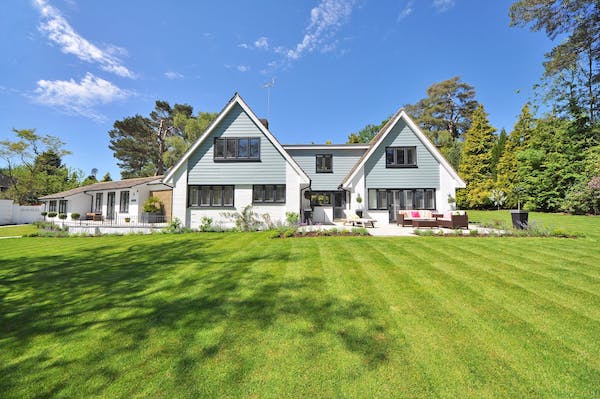
You spend money on fertilizer, weed killer, seed, and a new mower, and the lawn still looks worse than the neighbor who never touches their yard. Brown patches widen, weeds keep coming back, and the grass feels thin under your feet.
Most lawn damage comes from routine habits. A few wrong moves with the mower, hose, and spreader can turn a $75 fix into a $1,500 to $4,000 restoration. Sod replacement runs $1 to $2 per square foot plus $1,000 in install, and a broken irrigation system can add $500 to $2,500.
These are the six mistakes that quietly destroy grass. Fix the habits first, then spend on products only when the lawn actually needs them.
1. Mowing Too Short and Scalping the Crown
Cutting the grass low feels efficient, but a short lawn is a stressed lawn. When the blade drops below two inches on cool-season grasses like fescue and Kentucky bluegrass, you remove the leaf surface the plant needs to feed its roots.
Scalping also exposes the soil to direct sunlight. The crown dries out, and crabgrass and broadleaf weeds get the open ground they need to germinate. A single weekend of bad mowing in July can show up as brown stripes for the rest of the season.
Most cool-season lawns do best at three to four inches. Bermuda and zoysia can be cut shorter, around one to two inches, but only with a sharp blade. Never remove more than one-third of the leaf in a single pass.
Reseeding a visible front yard runs $500 to $2,500, and full sod replacement costs $1 to $2 per square foot plus $1,000 or more in install labor.
Raise the deck one notch, sharpen the blade twice a season, and mow more often instead of cutting deeper. If you have already burned out patches, expect to overseed in early fall, the same way you would after the damage covered in lawn care products that are killing your grass.
2. Watering at the Wrong Time of Day
A lawn watered at the wrong time fails twice. Watering in the evening leaves the blades wet overnight, which invites brown patch, dollar spot, and pythium fungus. Watering at midday loses up to half of the volume to evaporation.
Frequent shallow watering is the other half of the problem. When you sprinkle every day for ten minutes, roots stay near the surface chasing the moisture they can reach. The lawn looks green for a week, then collapses the first time temperatures hit the high 80s.
Water once or twice a week, early in the morning between 5 a.m. and 9 a.m., long enough to soak the top six inches of soil. For most yards that means about one inch of water per week, which you can measure with a tuna can on the lawn.
If your in-ground system is leaking, spraying the sidewalk, or stuck on an old controller schedule, repairs run $500 to $2,500. That is still cheaper than letting the grass die and paying $1,500 to $4,000 to restore the yard.
Check the controller every spring, replace cracked heads, and adjust the schedule for rainfall instead of letting the timer run during a storm. While you are out front, review the best flowers for your front yard, because borders fed by the same zone often die when the lawn schedule is wrong.
3. Applying Fertilizer to Dry, Stressed Grass
Spreading Scotts Turf Builder or Milorganite across a dry, heat-stressed lawn is one of the fastest ways to burn the roots and create the same brown patches you were trying to prevent.
High-nitrogen synthetic fertilizers cause the most visible damage. Apply too much in July and you get a sharp green flush followed by yellow streaks that match the pattern of the spreader. Apply during drought and you can scorch the crown in a few days.
Water the lawn the day before you fertilize so the soil is moist, then apply on a cool morning with no heat wave forecast for the next three days. Cool-season grasses feed best in early fall and again in spring. Slow-release organic options like Milorganite are more forgiving if you are unsure about timing.
A $40 bag of fertilizer can lead to $800 to $3,000 in reseeding and topdressing to fix the streaks. If the burn kills entire sections, full sod replacement at $1 to $2 per square foot plus $1,000 or more in install can push the total past $4,000.
Set the spreader to the rate the label requires, and avoid doubling up where you turn at the edges. Pair the next application with a soil test, the same logic used in the best ways to get rid of weeds.
4. Ignoring Soil pH and Compaction
A lawn can be watered, mowed, and fed correctly and still fail because the soil is wrong. Most cool-season grasses want a pH between 6.0 and 7.0. Below 5.5, nutrients lock up in the soil and the lawn cannot absorb the fertilizer you keep buying.
Compaction makes it worse. Years of foot traffic, mower wheels, and clay-heavy ground squeeze the air out of the root zone. Water runs off instead of soaking in, and the grass thins out along walkways, gates, and play areas first.
A soil test from your county extension office costs $15 to $25 and tells you the pH, the major nutrients, and how much lime or sulfur to add. Core aeration in early fall, followed by overseeding and a light topdressing of compost, will recover most struggling lawns.
Skip these steps and a thin patch turns into a full restoration project. By the time you call a landscaper, you are looking at $1,500 to $4,000 to reseed, topdress, and bring the soil back into range.
Aerate high-traffic zones, lime acidic soil in the fall, and pay attention to the areas where roots fail first. Healthy soil also feeds the rest of the yard, including the beds you stock with the best flowers to plant for spring and the shrubs covered in basic tree care.
5. Bagging Clippings and Using Dull Mower Blades
Bagging every clipping looks tidy, but it costs you free fertilizer. Grass clippings are about four percent nitrogen by dry weight, and mulching them back returns roughly a quarter of the nitrogen the grass needs in a season.
Dull blades cause a different kind of damage. A worn mower blade tears the leaf tip instead of slicing it, leaving a ragged white edge that turns brown within a day. From the street, the whole lawn looks washed out.
Sharpen the blade twice during the mowing season and balance it after each sharpening. A new blade for most walk-behind mowers costs $15 to $30, far cheaper than the brown frosting that shows up on a yard cut with a dull edge all summer.
Mulching with a sharp blade also reduces thatch instead of building it, despite the myth that clippings cause thatch. Letting wet thatch build up is also what attracts the kind of yard activity covered in the most common home infestations.
6. Using the Wrong Grass Species for Your Climate
Some lawns never had a chance. Planting Kentucky bluegrass in Phoenix or Bermuda in Vermont is a recipe for thin turf, constant watering, and a yard that fails every August.
Cool-season grasses like fescue, ryegrass, and Kentucky bluegrass thrive in the northern half of the country. Warm-season grasses like Bermuda, zoysia, St. Augustine, and centipede dominate the South, where heat and humidity would scorch a cool-season lawn by July.
The transition zone, which runs roughly from Virginia to northern California, is the hardest place to keep a lawn. Tall fescue and turf-type zoysia handle that band best, because they tolerate both summer heat and a real winter.
Guessing wrong is expensive. Full sod replacement with the correct species runs $1 to $2 per square foot plus $1,000 or more in site prep and install. For a 5,000 square foot yard, that is $6,000 to $11,000.
Match the species to the region before you spend another dollar on seed. A healthy lawn is part of how a home shows from the street, which is why curb appeal is one of the top items in smart upgrades to increase home value and in broader ways to increase the value of your home.
What Actually Works: A Lawn Routine That Saves Money
Healthy grass comes from routine, not panic buying. Mow high with a sharp blade, water deeply once or twice a week in the early morning, feed only when the soil and climate support it, and aerate compacted ground in the fall.
Start with a $25 soil test before you spread another bag of fertilizer. Match your fertilizer schedule to your grass type, not to the calendar on the bag. If you live in the transition zone, lean on tall fescue or zoysia.
If the lawn is already failing, fix one cause at a time. Repair the irrigation, raise the mower deck, sharpen the blade, aerate, overseed, and only then reach for a product. Guessing with more chemicals is how a $75 problem becomes a $4,000 restoration, and how a thin yard turns into the damp, debris-filled space that supports the conditions in our guide to eliminating pests around your home.
- 14shares
- Facebook0
- Twitter2
- Pinterest12