
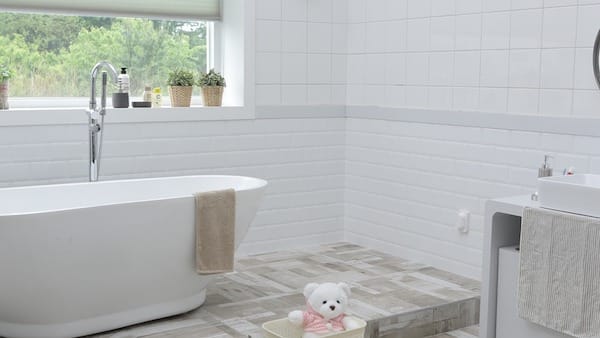
Your bathroom is the second most visible room when buyers tour your home. Small upgrades under $79 each deliver measurable returns at resale and lower your utility bills immediately. The key is choosing upgrades that fix real problems, not just trends.
Home buyers notice fixture quality, water efficiency, and maintenance first. When you upgrade with WaterSense-certified faucets, soft-close toilet seats, and modern showerheads, you signal that the bathroom has been cared for. That perceived value justifies higher asking prices and closes faster.
1. High-End Soft-Close Toilet Seat ($30 to $60)
A builder-grade toilet seat is the first thing a buyer opens. It’s loud, flimsy, and looks cheap. A soft-close seat from brands like Bemis or Kohler eliminates the slam, reduces wear on the hinge bolts, and feels like a luxury upgrade. Installation takes 10 minutes with a wrench.
Soft-close seats last 7 to 10 years compared to 3 to 4 years for standard seats. That durability reduces replacement cycles and gives you a head start on home value perception. Buyers spend an extra $40 on a house that feels well-maintained.
WaterSense ratings don’t apply to toilet seats, but the seat quality protects your toilet’s internal components. A bent flapper or cracked bowl costs $400 to $800 to repair. The soft-close hinge reduces stress on mounting hardware and extends your toilet’s life.
2. WaterSense Showerhead ($40 to $75)
Delta H2Okinetic and Moen Magnetix showerheads deliver strong pressure while cutting water use to 2.0 gallons per minute, compared to the federal standard of 2.5 GPM. The EPA certifies WaterSense showerheads save 2,700 gallons of water annually per household.
At average residential water rates of $8 per 1,000 gallons, you save approximately $22 per year on your water bill. Over a 10-year ownership, that’s $220 in direct savings. Installation is hand-tight onto your existing arm and requires no tools.
Buyers increasingly expect modern showerheads as a sign of maintenance. A corroded or leaking showerhead signals deferred maintenance. Installing a new, efficient model before listing protects your home value positioning and lowers utility costs for the next owner.
3. WaterSense Faucet Replacement ($50 to $79)
Pfister and Glacier Bay offer WaterSense faucets in the $60 to $79 range. These models restrict flow to 1.5 gallons per minute while maintaining acceptable pressure. Standard faucets use 2.2 GPM. Over a household’s 8.8 daily uses, you conserve 4.7 gallons per day.
That’s 1,716 gallons per year at $8 per 1,000 gallons, totaling $13.73 in annual savings. Replacing both bathroom faucets saves $27 per year. On a 30-year mortgage, that’s nearly $820 in cumulative water savings. Faucets take 15 to 20 minutes to install if you have a wrench and are comfortable turning off the shut-off valves.
A leaking faucet loses 3,000 gallons per year and costs $24 per year in wasted water alone. Replacing a dripping faucet is not optional if you plan to sell quickly. Inspectors flag it immediately.
4. Framed Mirror Upgrade ($40 to $79)
A builder-grade mirror is often unframed, large, and impersonal. A framed mirror in white, espresso, or natural wood creates visual warmth and defines the vanity as a focal point. Sizes range from 24 inches to 36 inches wide, fitting most standard bathroom layouts.
Mirrors also create the perception of more space and reflect light, making small bathrooms feel larger. Installation requires a level and screws into wall studs, a job most homeowners complete in 30 minutes. Some frames include small shelves for storing soap or candles.
Moisture degrades unframed mirrors over 5 to 10 years, causing black spots along the edges. A properly sealed framed mirror resists moisture better and looks intentional, not temporary. This upgrade demonstrates bathroom care to potential buyers.
5. LED Vanity Bulbs in 3000K to 4000K ($20 to $40)
Bathroom lighting is one of the easiest ROI upgrades. Replace standard incandescent bulbs with LED vanity bulbs rated for 3000K (warm white) to 4000K (cool white) color temperature. These bulbs last 25,000 to 50,000 hours, roughly 10 to 20 years of typical use.
A single LED bulb uses 8 to 12 watts compared to 60 watts for an incandescent bulb. If your vanity has four bulbs and you run them two hours daily, switching to LED saves 75 kilowatt-hours per year. At $0.15 per kWh, that’s $11.25 per year per fixture in direct energy savings.
LED vanity bulbs also render skin tones more accurately, making the bathroom feel more luxurious. Buyers notice lighting quality immediately upon entering. Replace all fixtures with consistent color temperature to avoid a mismatched, neglected appearance.
6. Modern Peel-and-Stick Subway Tile Backsplash ($25 to $50)
Peel-and-stick tile adheres directly to drywall without grout, mortar, or adhesive. Installation takes one to two hours for a 3-square-foot area. Brands like Aspect and Smart Tiles offer waterproof, mold-resistant options. They’re ideal for protecting the wall behind the sink from splash damage.
A traditional tile backsplash with grout costs $150 to $300 in labor and materials. Peel-and-stick eliminates that cost while delivering the same visual impact. If you’re renting or prefer not to commit to permanent installation, this is the quickest solution.
Properly installed, peel-and-stick tile lasts 3 to 5 years before edges begin lifting. For a resale situation, that’s enough time to show buyers a finished, intentional space. Repair of water damage behind the sink is expensive, so protecting that area is a priority against costly water damage claims.
7. Deep Caulk and Grout Cleaning ($15 to $30 in supplies)
Clean, white caulk and grout are non-negotiable for resale. Remove old caulk with a caulk removal tool, then apply 100-percent silicone caulk in matching white or clear. Grout haze on tile is removed with a grout haze cleaner or dilute hydrochloric acid following safety instructions.
Dirty caulk and dark grout are the first signs of a bathroom that has not been maintained. They cost nothing to replace, yet buyers interpret them as evidence of moisture problems and mold risk. Spending two hours on this task prevents misdiagnosis during inspections.
For $25 in supplies and a few hours of labor, you eliminate a major resale objection. Compare this cost to the hours spent defending the bathroom’s condition during negotiations. Fresh caulk and grout instantly improve the perception of cleanliness, directly supporting bathroom renovation payback.
What Actually Works: The Practical Next Step
These seven upgrades cost $270 to $412 total. They address three buyer concerns: maintenance, efficiency, and water damage risk. Buyers use these visible cues to estimate repair costs and decide whether to negotiate down or walk away.
Install upgrades in this order: clean caulk and grout first, then replace the toilet seat and faucets, then add the mirror and lighting. Paint or tile comes last, as these upgrades look intentional only if the fixtures are already current. Start with the upgrades that show the bathroom is maintained, then add the ones that show care and attention to detail.
Your goal is to show that the bathroom has not been neglected. Proven kitchen and bath upgrades add measurable value and lower buyer uncertainty. When inspectors find a clean, efficient, well-maintained bathroom with modern fixtures, they report confidence instead of risk. That confidence translates to faster sales and higher offers.
- 3shares
- Facebook0
- Twitter1
- Pinterest2