
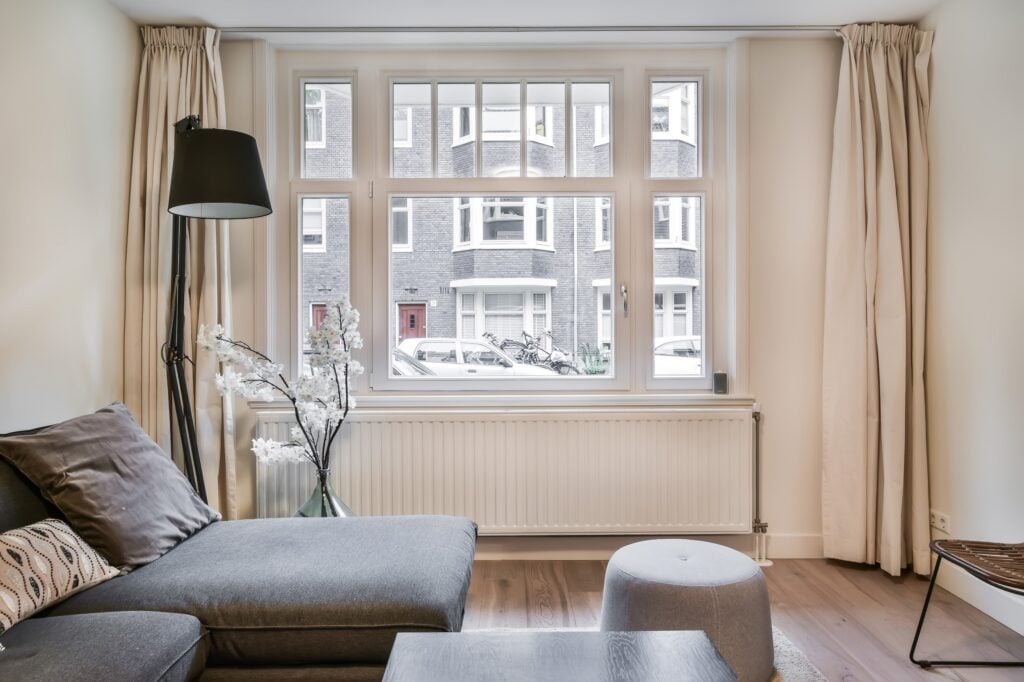
Your living room is the first impression buyers and appraisers form about your home’s condition and style. A single design mistake can trigger the “dated” label, shaving thousands off your home’s value before the tour ends. These seven common living room mistakes reveal outdated taste to trained eyes, each one costing you in resale value or the quality of your own daily experience.
1. Oversized Sectional Swallowing the Room (Replacement Cost: $800-$3,000)
An oversized sectional is the first sign of a space stuck in 2000s design. When a sectional consumes 60 percent of your floor area and forces chairs against the walls, the room feels cramped and warehouse-like instead of welcoming. The sectional’s bulk prevents natural traffic flow and makes smaller living rooms feel like dead space.
Modern living rooms prioritize proportion and breathing room. A appropriately scaled sofa or loveseat with a single accent chair creates better scale and allows you to arrange seating toward a focal point like a fireplace or window. This arrangement also improves traffic patterns through the room, protecting flooring and reducing damage.
Replacing an oversized sectional with right-sized seating costs $800 to $3,000 but immediately signals to potential buyers that your home was recently updated. The visual openness also makes the room feel larger, a critical selling point.
2. Floating Furniture Pushed to Walls (Professional Redesign: $200-$500)
Pushing all furniture to the perimeter of the room creates a furniture-store layout that screams “I do not understand interior design.” This arrangement kills conversation, makes the room feel disconnected, and exposes the center floor as empty and purposeless. Appraisers and buyers immediately sense something is wrong without knowing why.
Modern design groups seating to form an actual conversation zone, usually anchored by a center table 18 inches from the sofa. This furniture grouping should float 12 to 18 inches from walls, creating intentional negative space that feels deliberate and designed. The arrangement should encourage interaction rather than passive TV watching from separate zones.
Moving furniture costs nothing but time, though a professional designer consultation runs $200 to $500 and ensures correct proportions. This single change often produces the biggest visual impact, immediately aging the space out of “1990s family room” territory into something that feels intentional and curated.
3. Rug Too Small Under the Sofa (New Rug: $300-$1,500)
A rug that stops short of the sofa front legs or sits entirely under the sofa is one of the most obvious dating mistakes. This sizing error breaks the visual anchor that grounds your seating arrangement and makes the room feel unfinished, as if the budget ran out before completing the design.
Design standards require a rug to extend 6 to 12 inches past the sofa’s front legs on all sides. For a living room, this typically means an 8-by-10-foot rug as a minimum, pulling all seating into the rug’s boundary. This creates visual cohesion and signals that your space was deliberately designed by someone who understands proportion. A properly scaled rug also unifies your color palette and prevents the room from feeling fragmented.
Replacing an undersized rug with the correct size costs $300 to $1,500 depending on material and quality. The investment immediately lifts the perceived quality of your entire seating arrangement and is one of the fastest fixes for a dated living room.
4. Low-Watt Overhead-Only Lighting (Lighting Package: $80-$400 per fixture)
Relying on a single overhead fixture or ceiling light as your only source is an instant marker of 1980s or 1990s construction. This type of flat, shadow-creating light makes your space feel institutional and uninviting. Buyers and appraisers associate single-source overhead lighting with poor maintenance and lack of attention to detail.
Professional lighting requires three layers: ambient (overhead or recessed), task (reading and work areas), and accent (highlighting art or architectural features). A floor lamp for reading costs $40 to $200, a wall sconce pair runs $80 to $250, and recessed lighting installation is $100 to $400 per fixture depending on your ceiling type. Outdated fixtures also pose electrical safety concerns, another red flag for appraisers conducting inspections.
Adding even two lamps and a wall sconce transforms your room from institutional to sophisticated, showing buyers that you invest in the spaces you use daily. This upgrade costs $200 to $400 total and is among the highest-ROI improvements you can make.
5. Heavy Drapery Blocking Windows (Blind Replacement: $200-$800 per window)
Floor-to-ceiling velvet drapes or heavy thermal curtains dominated 1990s and 2000s living rooms. This dense fabric blocks natural light, makes your home feel closed-off, and signals outdated taste immediately. Contemporary homes celebrate windows and light rather than hiding them.
Modern homes favor motorized roller shades, cellular shades, or simple linen panels that allow light control without heaviness. These options cost $200 to $800 per window installed and provide clean, minimal aesthetics. Natural light also increases your home’s perceived value and makes rooms feel 20 percent larger to buyers.
Replacing heavy drapery signals that your home has moved into a new design era. Pairing your updated window treatments with fresh paint amplifies this effect and creates a cohesive, updated appearance throughout connected spaces.
6. Builder-Grade Ceiling Fan as Only Lighting (Fixture Replacement: $150-$600)
A basic brass or oak ceiling fan with a frosted light kit is the hallmark of builder-grade construction from the 1990s through early 2000s. This single fixture cannot provide adequate light, creates visual clutter on the ceiling, and immediately dates your entire room. Appraisers specifically note this as evidence the home has not been updated.
Replace the ceiling fan with a simple, low-profile recessed light or a statement flush-mount fixture that suits your design style. Installation costs $150 to $600 depending on complexity. This removes visual clutter and allows you to create proper three-point lighting with separate fixtures tailored to your layout.
If you need ceiling air circulation, choose a modern minimalist fan without the light kit. Low-cost lighting trends favor layered, adjustable solutions over single all-purpose fixtures that compromise both function and aesthetics.
7. Gallery Wall Too Small for Its Wall (Printing and Framing: $400-$1,200)
A small, scattered gallery wall on a large blank wall looks unfinished and hesitant, like the decorator ran out of confidence halfway through the project. Conversely, a properly proportioned gallery wall creates a powerful focal point that anchors your design and signals intentional curation.
Gallery walls should fill 60 to 75 percent of the wall space vertically and span 70 to 80 percent horizontally. A small 3-by-3 arrangement is dwarfed on an 12-foot-wide wall; instead, create a 4-by-5 or 5-by-6 grid that commands the space. This scale demonstrates confidence and design literacy to anyone entering your room.
Printing and framing 20 to 25 pieces costs $400 to $1,200 depending on frame quality and print method. This investment completely transforms an empty wall into a design statement and is one of the most visible upgrades you can make without major renovation.
What Actually Works: Creating a Home Buyers Cannot Ignore
Fixing these seven mistakes requires no structural renovation or major expense. Replacing an oversized sectional, scaling your rug correctly, adding layered lighting, updating window treatments, removing an outdated ceiling fan, and creating a properly proportioned gallery wall cost $2,000 to $5,000 total. These investments signal to appraisers and buyers that your home is current, well-maintained, and designed by someone who understands proportion and light.
Your living room is your home’s calling card. When you remove the dated design markers that lower perceived value, you immediately position your home in a higher category. These fixes are not about following trends; they are about honoring the principle that scale, light, and intentional arrangement create spaces that feel expensive and cared-for. Smart upgrades like these increase not only your home’s resale value but also your own enjoyment of the space you use most.
Start with your rug size and furniture scale. These two elements alone reset your room from dated to thoughtful, and everything else you add builds on that foundation. When you understand how appraisers evaluate your home, you see that the details that feel invisible to you are exactly what train professionals to value your property higher.
- 2shares
- Facebook0
- Twitter0
- Pinterest2